First-Time Homebuyer Guide
Your first home. Your biggest investment. Know what to expect.
Buying your first home is exciting—but it can also feel overwhelming. There are lenders, inspections, appraisals, insurance, contracts, title work, closing costs and plenty of terminology you may have never encountered before.
You don’t have to figure it all out alone.
My goal is to make the home-buying process easier to understand by keeping you informed, answering your questions and helping you understand what is happening at every step.
 Step 1: Know What You Can Afford
Before you start touring homes, it’s important to understand your financial picture.
Your home budget isn’t just about the purchase price. You also need to consider your:
- Monthly mortgage payment
- Property taxes
- Homeowners insurance
- HOA or community fees
- Utilities
- Maintenance and repairs
- Closing costs
The goal isn’t simply to qualify for a house. It’s to find a home you can comfortably afford.
 Step 2: Get Pre-Approved
A mortgage pre-approval helps you understand your purchasing power before you begin seriously shopping.
Your lender will generally review things such as your income, employment, credit and debts to determine how much financing you may qualify for.
Why get pre-approved?
It can help you:
Know your budget
Understand the price range you should be looking in.
Strengthen your offer
Sellers are generally more comfortable considering an offer when a buyer has already spoken with a lender.
Avoid surprises
You’ll have a better idea of what your financing may look like before you fall in love with a home.
Tip: Don’t make major financial changes while you’re buying a home without first talking with your lender. New credit, large purchases or changes in employment can potentially affect your loan.
 Step 3: Start Looking for Your Home
Now comes the fun part!
But before you start looking at homes, separate your needs from your wants.
Ask yourself:
What do I need?
- Number of bedrooms
- Number of bathrooms
- Location
- Work commute
- School considerations
- Accessibility
- Yard or garage
What would I like?
- Pool
- Updated kitchen
- Large backyard
- Waterfront
- Golf community
- Extra bedroom
- Outdoor living space
Knowing the difference can help you make better decisions when you’re comparing properties.
 Don’t Just Look at the House
A home may look perfect online, but the property itself is only part of the equation.
Before purchasing, you’ll want to understand things such as:
- Property taxes
- Homeowners insurance
- Flood zone considerations
- HOA fees and rules
- CDD fees, when applicable
- Community amenities
- Future development
- Location and surrounding area
- Potential resale considerations
The right home isn’t just a house you love. It’s a property that fits your lifestyle and your budget.
 Step 4: Making an Offer
When you find the right home, it’s time to make an offer.
But an offer isn’t always simply:
“I’ll pay this much.”
There are other important terms that may be part of the offer, including:
- Purchase price
- Financing
- Closing date
- Earnest money
- Inspection terms
- Appraisal considerations
- Seller concessions
- Other contract terms
I’ll help you understand the offer and the important terms before you make your decision.
 Step 5: You’re Under Contract!
Congratulations! But this is not the finish line.
It’s the beginning of an important part of the process.
During the contract period, several things may happen:
1. Deposit
Your required deposit is delivered according to the terms of the contract.
2. Inspection
The property is inspected to identify potential issues.
3. Appraisal
If you’re financing the purchase, your lender may order an appraisal to help determine the property’s value.
4. Loan Processing
Your lender continues working toward final loan approval.
5. Title Work
The title company researches the property’s ownership history and works toward preparing the transaction for closing.
6. Insurance
You’ll need to secure the appropriate homeowners insurance and satisfy your lender’s requirements.
7. Final Walkthrough
You’ll have an opportunity to make sure the property is in the expected condition before closing.
8. Closing
You sign the necessary documents, funds are transferred, and ownership is officially transferred.
Then comes the best part…
 You Get the Keys!
 Understanding the Home Inspection
A home inspection is an important opportunity to learn more about the property you’re purchasing.
An inspector may evaluate areas such as:
- Roof
- Structure
- Electrical systems
- Plumbing
- HVAC
- Windows and doors
- Appliances
- Attic
- Foundation
- Other accessible components
An inspection isn’t about finding a “perfect” house—because no house is perfect.
It’s about understanding the condition of the home so you can make informed decisions.
 Understanding the Appraisal
An appraisal is different from a home inspection.
Inspection = Condition
Appraisal = Value
When financing a purchase, the lender may require an appraisal to help determine whether the property’s value supports the loan.
If the appraisal comes in differently than the contract price, there may be additional decisions and negotiations to consider.
Understanding this before it happens can help prevent unnecessary surprises.
 What Will I Need to Pay?
One of the biggest mistakes first-time buyers make is focusing only on the down payment.
Depending on your specific situation, you may have expenses such as:
- Down payment
- Earnest money
- Inspection
- Appraisal
- Closing costs
- Prepaid taxes
- Homeowners insurance
- Escrow reserves
- HOA-related costs
- Moving expenses
- Immediate repairs or improvements
Your lender and other professionals involved in the transaction will provide the specific financial figures for your purchase.
My job is to make sure you understand what is happening and know what questions to ask.
 Common First-Time Buyer Mistakes
1. Looking at homes before knowing your budget
Getting emotionally attached to a home outside your comfortable price range can make the process much harder.
2. Forgetting about the additional costs
Your mortgage isn’t necessarily your total monthly housing expense.
3. Skipping the inspection
Saving money today could potentially create a much larger expense later.
4. Making major financial changes
Talk with your lender before making large purchases, opening credit accounts or making other significant financial changes during the mortgage process.
5. Being afraid to ask questions
There is no such thing as a stupid question when you’re buying your first home.
6. Assuming everything will happen automatically
There are many moving parts in a real estate transaction. Communication between the professionals involved is extremely important.
 My Approach to First-Time Buyers
I believe you should understand what you’re buying—and understand the process getting you there.
Buying my first home gave me a completely different perspective on what it’s like to be on the buyer’s side of the transaction.
There are a lot of moving parts in real estate. It’s one gigantic machine, with different people and different pieces working together to get you to the closing table.
When those pieces don’t communicate properly, problems can arise.
That’s why communication is so important to me.
I’ll take the time to explain things, answer your questions and keep you informed throughout the process.
My goal isn’t simply to help you buy a house.
It’s to help you become a confident homeowner.
 Ready to Take the First Step?
You don’t need to know everything before you begin.
That’s what I’m here for.
Whether you’re just starting to think about buying or you’re ready to speak with a lender, let’s talk about your goals and what your next step should be.
Let’s take the guesswork out of buying your first home.
New Construction vs. Resale Homes
Which is right for you?
One of the first decisions you’ll make when buying a home is whether to purchase new construction or a resale home.
Neither is automatically better. The right choice depends on your budget, lifestyle, priorities and how much time and maintenance you’re willing to take on.
 New Construction
Pros
Brand-new home and systems
Modern floor plans and features
Energy-efficient construction
Builder warranty may be available
Opportunity to choose finishes and upgrades
Less immediate maintenance
Cons
Upgrades can add up quickly
Model homes often include upgrades that aren’t included in the base price
Construction delays are possible
You may have to wait to move in
HOA and community fees may apply
New communities may still be developing
Resale Homes
Pros
Established neighborhoods and landscaping
What you see is generally what you get
More locations and homes to compare
Renovations may already be completed
Potentially more room for negotiation
Often available for a quicker move-in
Cons
Older roofs, HVAC, plumbing or electrical systems may need attention
Maintenance and repairs can be more immediate
Energy efficiency varies
Previous renovations should be evaluated carefully
Insurance costs can vary depending on the home’s age and condition
Needs vs. Wants
Before you start looking, make two lists.
Your Needs
Things you must have:
Bedrooms • Bathrooms • Location • Budget • Garage • Accessibility • Waterfront/canal • Community requirements
Your Wants
Things you’d love to have:
Pool • Outdoor kitchen • Upgraded finishes • Golf view • Large lot • Luxury bathroom • Three-car garage
My advice: Buy based on your needs first, then see which wants fit comfortably within your budget.
Don’t Forget the Total Cost
The purchase price isn’t the entire cost of owning a home.
Consider:
Mortgage + Taxes + Homeowners Insurance + HOA/Community Fees + Maintenance + Utilities
Insurance Matters
Florida insurance can be an important factor when comparing homes.
For resale properties, pay close attention to the age and condition of the roof, electrical, plumbing and other major systems.
New construction may have newer building components, but it doesn’t automatically mean inexpensive insurance.
Depending on the property and location, flood insurance may also need to be considered separately.
Before purchasing, get an insurance quote for the specific property.
Buying New Construction
Buying from a builder is different from buying a resale home.
Before signing, ask:
What’s included in the base price?
Which features are upgrades?
How much will my selected upgrades cost?
Is there a lot premium?
What are the HOA and other community fees?
Are there additional taxes or assessments?
When will the home be completed?
What happens if construction is delayed?
Can I have independent inspections?
What warranty is provided?
What future development is planned around my home?
Are there restrictions on boats, RVs, rentals or other property uses?
Don’t Forget the Model Home
The model is designed to sell you the dream.
Ask for a detailed list of exactly what is included in the price you’re being quoted.
Choosing the Right Builder
Not every builder offers the same level of quality, service or customization.
Look at:
Reputation • Construction quality • Warranty • Communication • Standard features • Upgrade pricing • Reviews • Construction timelines
And don’t be afraid to ask:
“How does this builder treat homeowners after the closing?”
What Type of New Home Is Right for You?
Production
A proven floor plan with predetermined options.
Good for: Buyers who want simplicity, predictable choices and potentially faster decisions.
Semi-Custom
A builder’s existing plan with more opportunities to personalize the home.
Good for: Buyers who want personalization without designing an entire home from scratch.
Custom
A home designed around your specific property, lifestyle and preferences.
Good for: Buyers who want maximum flexibility and personalization.
Luxury Custom
Higher-end materials, finishes, design and craftsmanship with extensive personalization.
Good for: Buyers looking to create a highly personalized home and lifestyle.
So Which Should You Buy?
Consider New Construction if you:
 Want a brand-new home Prefer modern features Want customization Want newer major systems Prefer a builder warranty Don’t mind waiting
Consider Resale if you:
Want an established neighborhood Prefer mature landscaping Want to see exactly what you’re buying Want more location choices Want to move sooner Don’t mind potential maintenance or renovations
My Approach
My job isn’t to convince you to buy new construction or resale.
My job is to help you understand the differences, ask the right questions and look at the complete picture before you make one of the biggest purchases of your life.
Educate. Communicate. Protect your interests.
That’s how I believe real estate should be done.
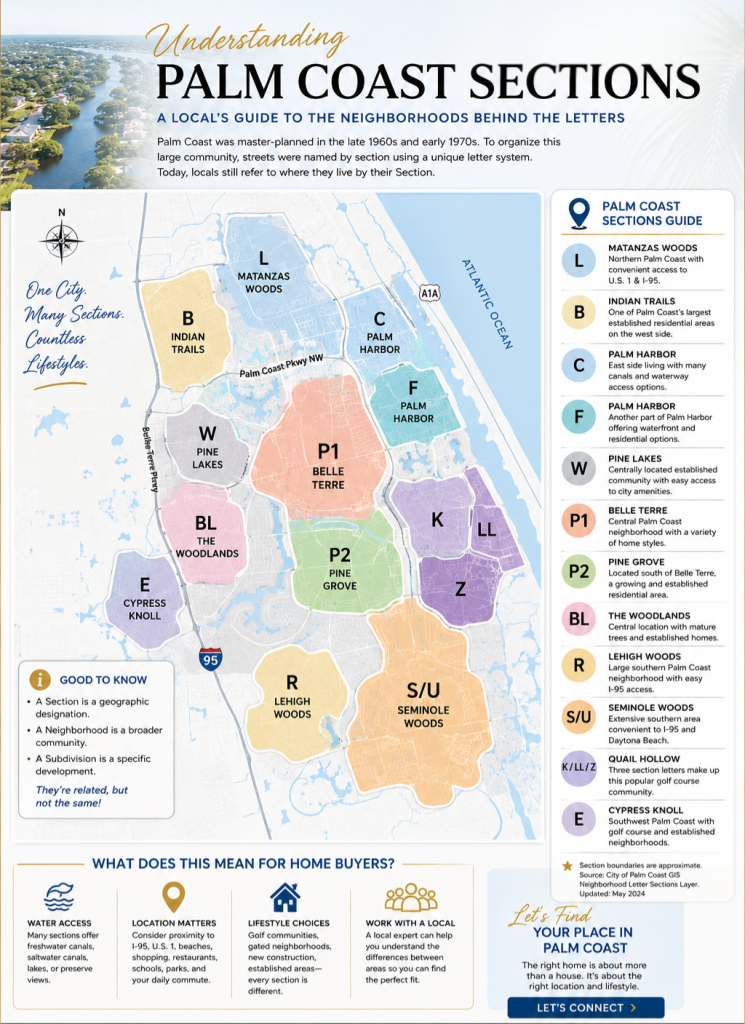
Understanding Palm Coast's Sections
A Local’s Guide to the Letters Behind the Neighborhoods
If you’ve spent any time looking at homes in Palm Coast, you’ve probably heard people say things like “B Section,” “P Section,” or “R Section.”
But what do those letters actually mean?
Palm Coast was designed as a master-planned community, and its sections were created as part of that original design.
In the early 1970s, engineer Eric Felter was hired by ITT/Levitt Community Development Corporation to organize and name Palm Coast’s streets.
By 1973, Felter had named approximately 4,500 streets across 84 neighborhoods.
His system grouped streets geographically, creating the letter-based sections that are still commonly used by Palm Coast residents today.
PALM COAST SECTIONS
NORTHERN PALM COAST
L Section — Matanzas Woods
A growing area in northern Palm Coast with a mix of newer homes and established neighborhoods.
B Section — Indian Trails
One of Palm Coast’s established areas, known for its residential neighborhoods and convenient location.
EASTERN PALM COAST
C & F Sections — Palm Harbor
Located closer to the Intracoastal Waterway, these areas include established neighborhoods and homes with varying proximity to water.
CENTRAL PALM COAST
W Section — Pine Lakes
One of Palm Coast’s original residential areas and home to some of the community’s earliest development.
P1 — Belle Terre
A centrally located area with established neighborhoods and convenient access to major roads and amenities.
P2 — Pine Grove
Another central Palm Coast area offering a variety of residential communities.
BL Section — The Woodlands
A residential area with a mix of established and newer homes.
WEST & SOUTHERN PALM COAST
R Section — Lehigh Woods
A large residential area with many newer homes and continued development.
S & U Sections — Seminole Woods
A large southern Palm Coast area offering a variety of home styles, lot sizes, and newer construction.
K, LL & Z Sections — Quail Hollow
Several sections make up the Quail Hollow area, with residential development continuing throughout the area.
E Section — Cypress Knoll
An established community located in southern/central Palm Coast.
QUICK SECTION GUIDE
| Section | Area |
|---|---|
| B | Indian Trails |
| BL | The Woodlands |
| C | Palm Harbor |
| E | Cypress Knoll |
| F | Palm Harbor |
| K | Quail Hollow |
| L | Matanzas Woods |
| LL | Quail Hollow |
| P1 | Belle Terre |
| P2 | Pine Grove |
| R | Lehigh Woods |
| S | Seminole Woods |
| U | Seminole Woods |
| W | Pine Lakes |
| Z | Quail Hollow |
SECTION ≠ NEIGHBORHOOD
One important thing to understand:
A Palm Coast section is a geographic designation. It isn’t necessarily the same thing as a neighborhood, subdivision, or HOA.
Over the years, Palm Coast has continued to grow, and newer developments don’t always follow the original street-naming system perfectly.
That’s why knowing the section is helpful—but it’s only one part of understanding a property.
WHICH SECTION IS RIGHT FOR YOU?
When you’re searching for a home in Palm Coast, I recommend looking beyond the section letter.
Consider:
Location
How close are you to work, shopping, schools, beaches, and major roads?
 Water
Do you want canal, lake, Intracoastal, or ocean access—or does water not matter to you?
Home
Are you looking for new construction, an established home, a larger lot, or something low-maintenance?
 Lifestyle
Do you want to be closer to restaurants, parks, golf, trails, the beach, or boating?
Budget
Different areas can offer very different home prices, HOA costs, insurance considerations, and property characteristics.
LET’S FIND YOUR PLACE IN PALM COAST
Palm Coast’s sections are part of what makes this city unique.
Whether you’re a first-time homebuyer, relocating to Florida, or looking for your next home, understanding the different areas can make your search much easier.
Don’t just find a house.
Find the area that’s right for your life.
Let’s explore Palm Coast together.
Palm Coast's Sections Map
GOLF, WATER & BOAT LIFE
Find the Palm Coast lifestyle that fits you.
Imagine starting your morning with a round of golf, spending the afternoon on the water, and ending the day relaxing in your own backyard.
In Palm Coast, you don’t necessarily have to choose between golf and the water. There are communities and neighborhoods where you can find golf-course living, Intracoastal views, saltwater canals, private docks, marina access, or a combination of these lifestyles.
But not every waterfront property offers the same boating experience. That’s where knowing the different areas—and understanding the waterway behind the property—becomes important.
 GRAND HAVEN
Golf • Gated Community • Intracoastal Lifestyle
Grand Haven is one of Palm Coast’s best-known gated golf communities. The community is located along the Intracoastal Waterway and is centered around an 18-hole Jack Nicklaus Signature golf course.
Buyers can find a variety of homes and properties, including homes near the golf course and properties along or near the Intracoastal.
Lifestyle:
Golf • Gated living • Walking trails • Clubhouse • Intracoastal setting
Best for buyers looking for:
A golf-centered community with a strong active-lifestyle atmosphere and access to the beauty of the Intracoastal.
 PALM HARBOR — C & F SECTIONS
Saltwater Canals • Private Docks • Boating
If boating is one of your priorities, Palm Harbor deserves special attention.
The C and F Sections contain Palm Coast’s well-known saltwater canal system, with select properties offering waterfront lots, docks and access toward the Intracoastal Waterway.
This area is particularly attractive to buyers who want to step outside their back door and get on the water.
Lifestyle:
Boating • Fishing • Kayaking • Waterfront living • Golf nearby
Best for buyers looking for:
A more traditional Florida waterfront lifestyle without necessarily being in a gated community.
Important:
Not every canal property has the same navigability. If you’re buying specifically for your boat, the individual canal, water depth, bridges and route to the Intracoastal need to be evaluated before purchasing.
 MARINA DEL PALMA
A Boating-First Community
For buyers who put boating at the top of their list, Marina del Palma is an area worth exploring.
This gated community was designed around a boating lifestyle, with marina facilities and waterfront-oriented amenities.
Lifestyle:
Boating • Marina living • Gated community • Waterfront lifestyle
Best for buyers looking for:
A community where boating isn’t simply an amenity—it’s part of the lifestyle.
TIDELANDS
Intracoastal Living • Gated Community
Tidelands offers another opportunity for buyers who want to be close to the Intracoastal Waterway.
The gated community includes a mixture of residences and emphasizes waterfront views, trails and outdoor living.
Lifestyle:
Intracoastal • Gated living • Walking trails • Water views
Best for buyers looking for:
A waterfront-oriented community without necessarily needing a private canal-front home.
 YACHT HARBOR VILLAGE
Marina • Intracoastal • Resort Lifestyle
For buyers looking for a more upscale boating environment, Yacht Harbor Village places residents in the Hammock Beach area along the Intracoastal Waterway, with marina access and proximity to resort amenities.
Lifestyle:
Boating • Marina • Golf • Resort amenities • Intracoastal
Best for buyers looking for:
A combination of boating, golf and resort-style coastal living.
GOLF WITHOUT GIVING UP THE COASTAL LIFESTYLE
Golf doesn’t have to mean being far from the water.
Palm Coast offers several golf-oriented communities and neighborhoods, including:
GRAND HAVEN
Gated golf community with an Intracoastal setting.
PALM HARBOR
Established neighborhood with saltwater canals and Palm Harbor Golf Club nearby.
PINE LAKES
An established Palm Coast neighborhood surrounding the Pine Lakes Golf Course.
CYPRESS KNOLL
An established golf-oriented area surrounding Cypress Knoll Golf & Country Club.
HAMMOCK BEACH / OCEAN HAMMOCK
Coastal golf living with the Atlantic Ocean and Intracoastal Waterway nearby. Ocean Hammock is associated with the Jack Nicklaus-designed Ocean Course.
HAMMOCK DUNES
A private gated coastal community centered around a private country-club lifestyle and 36 holes of championship golf.
NOT ALL WATERFRONT IS THE SAME
This is one of the most important things I want buyers to understand.
A home can have a beautiful canal view and still not be the right property for your boat.
Before purchasing a waterfront property, we should look at:
Canal depth
Will the water accommodate the type and size of boat you own?
Bridge clearance
Can your boat physically make it from the property to the Intracoastal?
Dock configuration
Does the existing dock work for your boat, or will modifications be necessary?
Tidal conditions
How does water depth change with the tide?
Route to the Intracoastal
How far is the property from navigable water?
Dock permits & restrictions
Are there existing permits, HOA restrictions or local requirements?
Insurance & flood considerations
Waterfront properties can have different insurance and ownership considerations than inland properties.
That’s why I don’t just want to show you a house with a canal behind it.
I want to help you understand the water you’re actually buying.
FIND YOUR VERSION OF THE FLORIDA LIFESTYLE
Maybe your dream is:
Golf in the morning.
Boat in the afternoon.
 Watch the sunset from your backyard.
Come home to a quiet gated community.
Or maybe you simply want a home where you can enjoy the beauty of the water without owning a boat.
Palm Coast has options for all of these lifestyles.
The key is finding the right neighborhood, the right property and the right type of water access for you.
LET’S FIND YOUR PLACE ON THE MAP.
If you’re looking for a home in Palm Coast where golf, water or boating are part of the lifestyle you’re after, I’ll help you narrow down the areas that make the most sense for your needs.
Let’s find the neighborhood that fits the way you want to live.